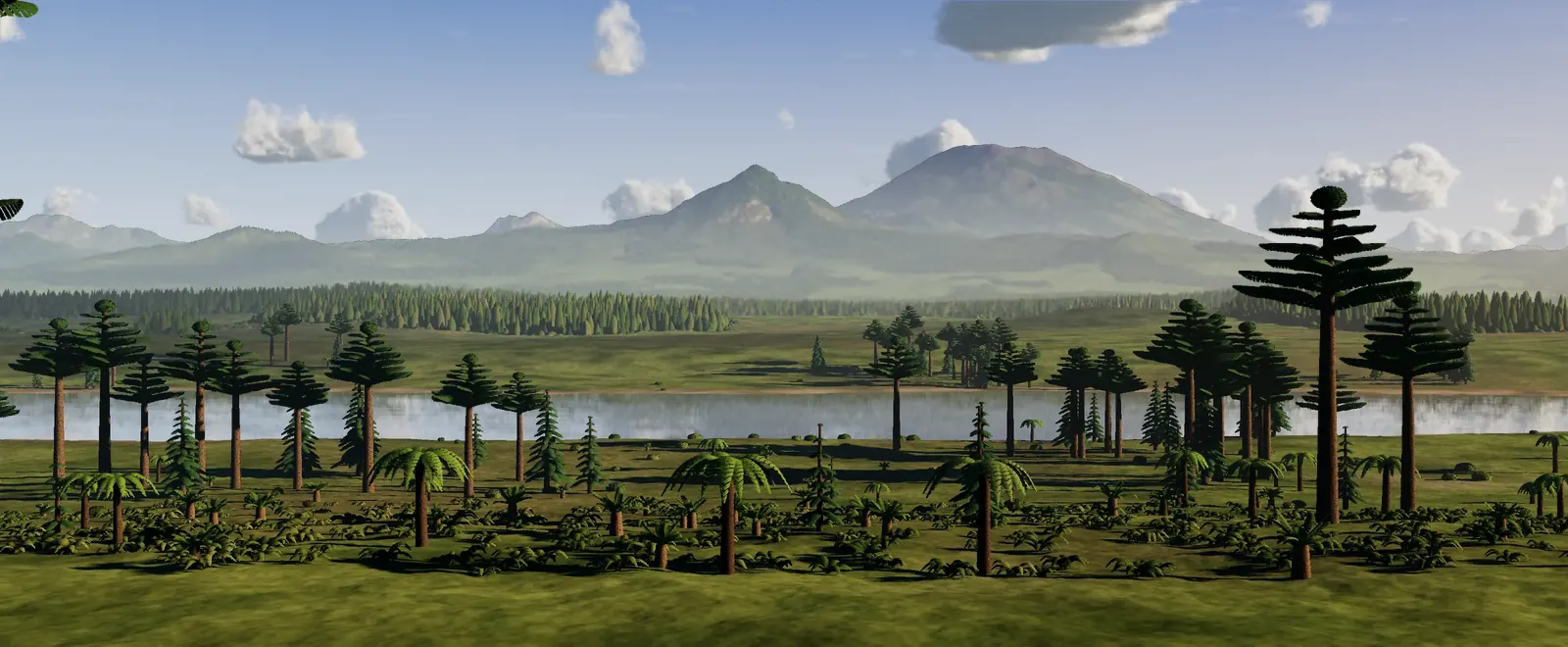

The Triassic-Jurassic extinction event occurred about 201 million years ago, at the boundary between the Triassic and Jurassic periods, and it is counted among the five major mass extinctions in Earth's history. Many marine and land species vanished, including most conodonts, which were small eel-like animals, and many large reptile groups other than the ancestors of crocodiles and the dinosaurs. The most widely supported cause is massive volcanic activity associated with the breakup of the supercontinent Pangaea, in a region called the Central Atlantic Magmatic Province, which released large amounts of carbon dioxide and other gases and probably caused warming and ocean acidification. With competing groups gone, the dinosaurs diversified and came to dominate the Jurassic world.
Before and after
- about 375 million years agoFish with limbs begin to walk: tetrapods evolve
- about 372 million years agoLate Devonian extinction
- about 252 million years agoPermian-Triassic mass extinction
- about 225 million years agoThe first mammals appear
- about 201 million years agoTriassic-Jurassic mass extinction
- about 150 million years agoArchaeopteryx, the earliest known bird, lives in Jurassic Bavaria
- about 66 million years agoCretaceous-Paleogene mass extinction
- about 56 million years agoPaleocene–Eocene Thermal Maximum
- about 34 million years agoAntarctica freezes over
More in Evolution & life
- from 56th century BCE to 20th century BCESumer
- from c. 3,300 BCE to 600 BCEBronze Age
- from 3rd millennium BCE to 2nd millenniumMaya civilization
- from 13th century BCE to 6th centuryAncient Greece
- from 1200 to 1523Aztec
- 24 November 1974Discovery of Lucy
The era
This moment belongs to the Mesozoic (252 million years ago to 66 million years ago), the age of dinosaurs.