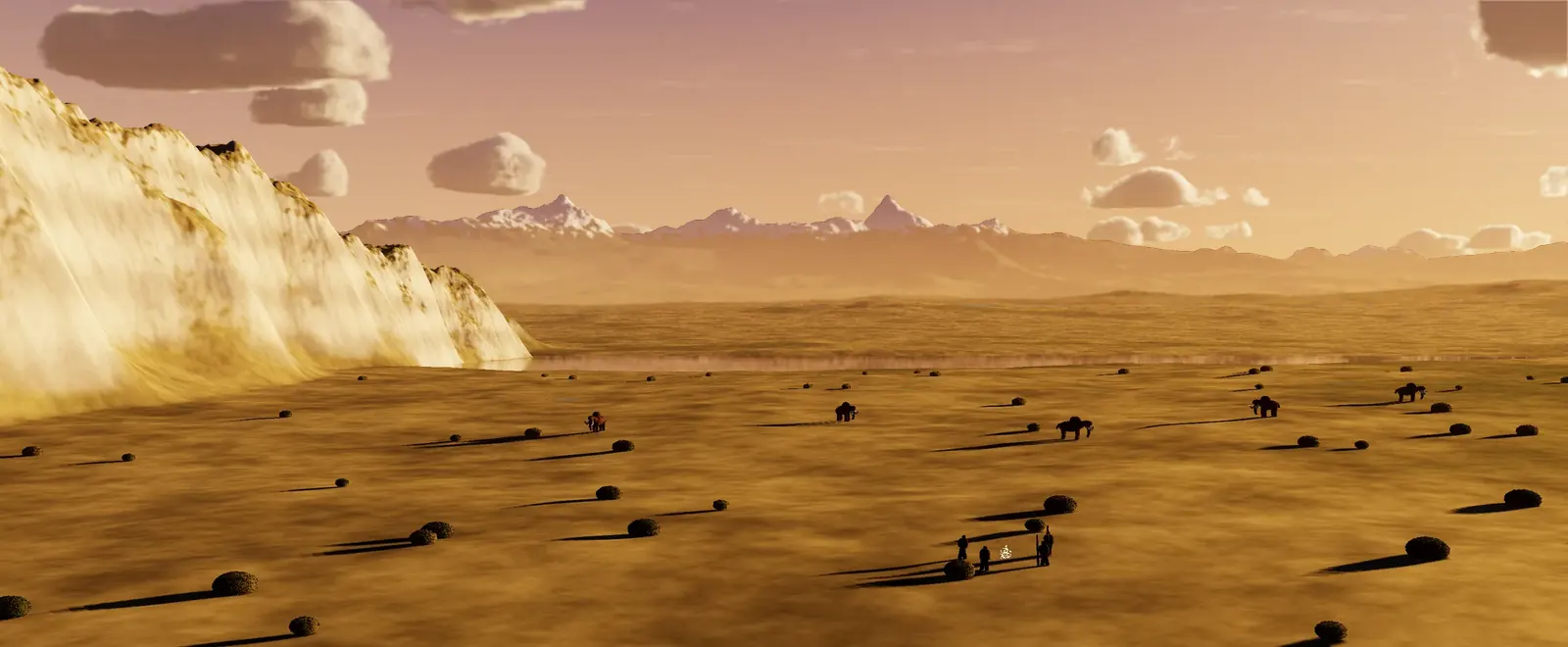

Fossilised human footprints preserved in the mud of an ancient lake at White Sands National Park, New Mexico, were dated in 2021 to between 21,000 and 23,000 years ago, and confirmed with a different technique in 2023. They show that people were living in North America during the Last Glacial Maximum, thousands of years earlier than the 'Clovis-first' model suggested, when an ice-free corridor opened some 13,000 years ago. The footprints belong mainly to teenagers and children, and they provide direct evidence of daily life. Settlement probably came along the Pacific coast.
Before and after
- about 41,000 years agoNeanderthals disappear from Europe
- from about 40,000 years ago to 31,000 years agoAurignacian
- about 36,100 years agoChauvet cave paintings are made
- about 30,100 years agoThe Venus of Willendorf is carved
- about 23,100 years agoPeople are already in North America
- about 21,000 years agoLast Glacial Maximum
- about 20,000 years agoThe earliest known pottery is made in China
- from about 17,000 years ago to 12,000 years agoMagdalenian
- from about 16,000 years ago to 8th millennium BCEEpipaleolithic
More in Evolution & life
- from c. 9,050s BCE to 8,850s BCEClovis culture
- 76th century BCECats begin to live with farmers
- from c. 5,600s BCE to 4,900s BCELinear Pottery culture
- from 55th century BCE to 45th century BCEVinča culture
- from 36th century BCE to 18th century BCECaral–Supe civilization
- from c. 3,500 BCE to 2,500 BCEAfanasevo culture
The era
This moment belongs to the Human prehistory (300,000 years ago to 3,200 BCE), the human story before writing.